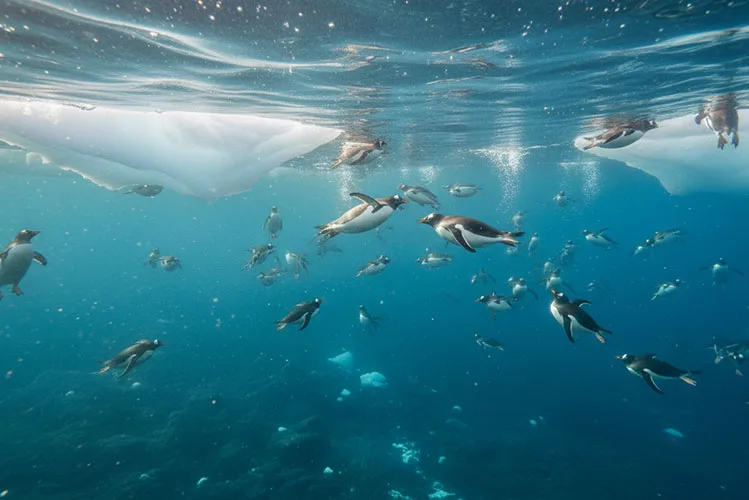
I’ve always loved the idea that animals have entire conversations we can’t quite hear, like eavesdropping on a party through the wall but only catching laughter or a sudden gasp. Turns out, scientists recently confirmed that penguins, yes, those wobbly tuxedo birds we usually see sliding on ice, are carrying on with their own chatter while diving for food. And not just random noise either. Calls. Repeated. Purposeful. Almost like an underwater group text with terrible reception.
The research wasn’t a quick one-off. It spanned two full years, equivalent of two breeding seasons, focusing on Gentoo penguins in Antarctic waters near King George Island where Gentoo penguins thrive. The team, led by Dr. Lee from the Korea Polar Research Institute, strapped lightweight cameras and microphones (seriously, just an ounce each, smaller than the packet of soy sauce that inevitably leaks in your lunch bag) onto the backs of these birds.
What they got back was a treasure chest of footage: tens of hours showing penguins gliding through icy green water, calling out to each other in bursts that carried through the water, almost like electronic pings, though they’re not echolocation. The scientists analyzed nearly 600 of these offshore calls, which was already more than anyone had managed before, since recording underwater is notoriously tricky. On land, penguins are loudmouths. Underwater, they’re elusive, like someone whispering into a pillow. To be more precise, underwater, their calls are harder for us to detect. Short bursts at frequencies that human ears struggle to pick up, almost like whispers we’re not tuned in for.
The unexpected pattern
Here’s the twist: after specific calls, the penguins would suddenly alter their behavior. Instead of continuing deep dives in one location, groups would shift, making shorter dives and sometimes relocating entirely to another patch of sea. Think of a crowd at a buffet, everyone lines up at the shrimp platter, then one person shouts “better dumplings over here!” and suddenly the whole group shuffles sideways.
Dr. Lee described these calls as coordination tools, not signals for attack or panic, but gentle nudges to keep the hunting party together. Safety in numbers, yes, but also efficiency. If you’ve ever tried chasing sardines alone in a vast ocean, you’d probably want backup too.
Still, the scientists couldn’t say with confidence that the calls improved hunting success. Prey counts didn’t surge when penguins vocalized. Instead, it looked more like a social glue, keeping the group aligned.
Why does this matter?
Some might shrug. Birds talk, big deal. But communication in the ocean is messy business. Sound carries differently underwater. Sound travels over four times faster in water than in air, and it can carry farther, especially at low frequencies. To human ears it often seems muffled and hard to localize, but for marine animals, water is actually an excellent medium for transmitting sound. To find out that penguins are making use of it during hunts adds another puzzle piece to the broader (and sometimes controversial) study of animal language. Dolphins get most of the press with their whistles, but now penguins can stand, or wobble, beside them in the line of “species suspected of having complex social calls”.
And it’s also a gentle reminder that humans, in our constant hunger for proof that we aren’t alone in the world of chatter, keep pushing into these corners. Attaching gadgets, gathering hours of tape, squinting at grainy spectrograms. It’s obsessive. Yet, there’s something oddly comforting about knowing these birds, far from WiFi and phone towers, still crave a way to say “stay with me”.
The tech behind the discovery
The cameras used were tiny, waterproof, and designed to fall off after a short period, so penguins weren’t harmed. In fact, the study went out of its way to minimize interference: no clunky contraptions, no risk of snagging. A delicate balance between science and ethics, something wildlife researchers still wrestle with daily.
Microphones captured frequency ranges that the human ear barely picks up, translating them into squiggly lines on computer screens. Each call had its own frequency signature, slightly higher here, stretched there. The meaning isn’t fully mapped yet, but differences suggest multiple “words” or at least variations.
It reminded me of how my dog growls in three slightly different pitches: one for “get off my couch”, one for “there’s a stranger at the door”, and another just because the wind moved a leaf in a way she didn’t like.
Emotional layers we project
Maybe we’re too eager, projecting friendship, teamwork, even kindness into these calls. But why not? Humans have always read themselves into animal stories. Remember when we all got sentimental watching the viral video of the penguin that visits the fisherman every year in Brazil? Or the penguin colonies livestreamed during lockdowns? Half of us stayed logged in longer than we’d ever admit.
I listened to a clip of these underwater calls (shared at a recent conference), and my first impression wasn’t science-y at all. To me, the call sounded almost lonely, like a faint beep echoing down an empty hallway. Scientists don’t attribute emotion to the sound, but its sparse, isolated quality leaves that impression.
How it ties into current climate worries
The study also lands in a period where Antarctic ecosystems are changing faster than researchers can keep up. Just this past July, massive ice sheets calved into the sea near the Antarctic Peninsula, raising concerns about prey distribution for penguins. If food sources scatter, communication might matter even more, keeping groups cohesive in unpredictable waters.
There’s also noise pollution creeping into polar seas. Ships, drilling, even experimental projects leave acoustic clutter. For animals relying on vocal signals, that’s not just an annoyance, it’s a potential threat. Imagine trying to whisper instructions to a friend during a rock concert.
The questions left hanging
What the researchers don’t yet know:
- Do calls differ by colony, almost like regional accents?
- Are young penguins born knowing them, or do they learn by imitation?
- And, crucially, does the vocal coordination actually increase survival rates over decades, or is it just a quirky byproduct of social instinct?
These aren’t small questions. They’re the kind of long-term mysteries that keep graduate students awake at 2 a.m. while staring at frozen audio files.
I can’t shake the image of penguins huddling at the surface, one giving a short bark underwater, and then everyone redirecting in perfect synchrony. It reminded me of group chats with my siblings where one cryptic message “don’t go there, long lines” is enough to change dinner plans for the whole crew. Communication doesn’t always need precision. Sometimes it’s just enough to redirect the flock.
Where this might go
The team behind the study plans to expand with newer tech: smaller sensors, longer battery lives, clearer sound. There’s also talk of pairing underwater calls with drone footage above the sea, syncing what’s seen from the air with what’s heard below. It sounds like science fiction, but given how fast technology sneaks ahead (remember when GoPros first came out and suddenly everyone had extreme sports footage?), it’s probably just around the corner.
Whether these penguins are strategizing like generals or just staying together out of instinct, their calls slice through the myth of silent seas. There’s chatter down there, faint to our ears but steady and clear to the penguins themselves. And maybe, just maybe, while we keep trying to decode them, they’re rolling their eyes, if penguins could, thinking “You humans really overthink everything”.
Tags: penguin communication, gentoo penguins, penguin calls, penguin behavior, antarctic penguins, animal communication research, penguin hunting, underwater penguin sounds, how penguins communicate, dl018


